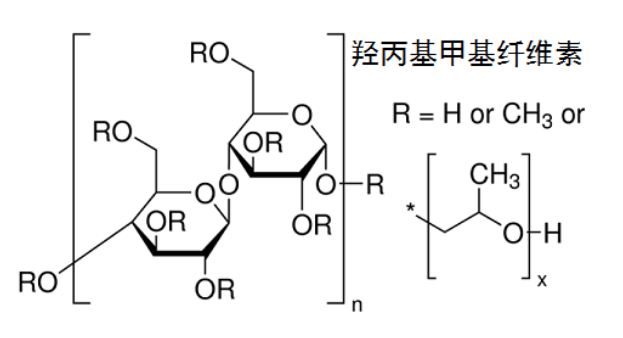
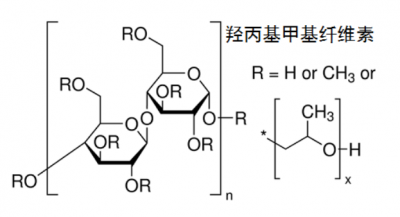
C18H38O14
Hydroxypropyl methyl cellulose is the propylene glycol ether of methylcellulose, in which the hydroxypropyl and methyl groups are combined with the anhydrous glucose ring of cellulose through ether bonds. It is a white to off-white cellulose powder or granule, and has the characteristics of cold water solubility and hot water insolubility similar to methylcellulose. Its solubility in organic solvents is better than water solubility, and it can be dissolved in anhydrous methanol and ethanol solutions, as well as in organic solvents such as chlorinated hydrocarbons and ketones. Dissolved in water, its aqueous solution has surface activity and forms a thin film after drying. After heating and cooling, it undergoes a reversible transformation from sol to gel. It can be used alone in cold drinks or in combination with other emulsifiers and stabilizers. The dosage in cold drinks is 1%. In recent years, it has been widely used in petrochemical, papermaking, leather, textile printing and dyeing, medicine, food, cosm.
1. Properties: This product is a white or slightly yellowish powder that is odorless, tasteless and non-toxic.
2. Water solubility and thickening ability: This product can be dissolved in cold water to form a transparent viscous solution.
3. Dissolution in organic solvents: Because it contains a certain amount of hydrophobic methoxy groups, this product can be soluble in some organic solvents and solvents mixed with water and organic matter.
4. Salt resistance: Since this product is a non-ionic and non-polymer electrolyte, it is relatively stable in aqueous solutions of metal salts or organic electrolytes.
5. Surface activity: The aqueous solution of this product has surface activity, making it emulsifying, protective colloid and relatively stable.
6. Thermal gelation: When heated above a certain temperature, the aqueous solution of this product can become opaque, generate precipitation, and cause the solution to lose viscosity. But it returns to its original solution state after gradually cooling. The temperature at which condensation and precipitation occurs depends on the type of product, the concentration of the solution and the heating rate.
7. Low ash content: Since this product is non-ionic, it can be effectively refined by washing with hot water during the preparation process, so its ash content is very low.
8. PH stability: The viscosity of the aqueous solution of this product is relatively stable in the range of PH3.0-11.0.
9. Water retention effect: Because this product is hydrophilic and its aqueous solution is highly viscous. It is added to mortar, plaster, paint, etc. to maintain high water retention in products.
10. Shape retention: Compared with other water-soluble polymers, the aqueous solution of this product has special viscoelastic properties. Its addition can improve the ability to maintain the shape of extruded ceramic products.
11. Lubricity: Adding this product can reduce the friction coefficient and improve the lubricity of extruded ceramic products and cement products.
12. Film-forming properties: This product can produce strong, flexible, transparent flakes, with good oil and ester resistance.
Specification
| Specification: | ranges mpa.s: | Specification: | ranges mpa.s |
| 5 | 3-9 | 8000 | 7000-9000 |
| 15 | 10-20 | 10000 | 9000-11000 |
| 25 | 20-30 | 20000 | 15000-25000 |
| 50 | 40-60 | 40000 | 40000 |
| 100 | 80-120 | 60000 | 46000-65000 |
| 400 | 300-500 | 80000 | 66000-84000 |
| 800 | 700-900 | 100000 | 85000-120000 |
| 1500 | 1200-2000 | 150000 | 130000-180000 |
| 4000 | 3500-4500 | 200000 | ≥180000 |
Add: A5-2702, Yuehai Xintiandi, Jinfeng District, Yinchuan City, Ningxia Hui Autonomous Region
Add: A5-2702, Yuehai Xintiandi, Jinfeng District, Yinchuan City, Ningxia Hui Autonomous Region
We use cookies to understand how you use our site and to improve the overall user experience. This includes personalizing content and advertising. Read our Privacy Policy